
The aim is a useful conversation and an accurate record. A single marker or GPS estimate does not tell the whole story.
Check what kind of drive it is.
Open a drive in History. A recorded session may include a route, speed information, and moments marked on the map. A manual entry contains the information you entered, without a recorded route or speed graph. Interrupted sessions are identified separately from completed practice.
Start with the date, duration, learner, and any notes. These are often more useful than immediately studying every point on a map.
Keep estimates and observations in context.
For recorded drives, the report shows which positions were recorded, where the app could estimate a position, and where information is missing. Its speed graph and observations help you move through the session. GPS reception and accuracy affect what can be shown; a missing segment does not prove where the car went.
Good and Review markers reflect what the supervisor entered. Intervention records a moment when they chose to note stepping in. These are not automatically detected violations or a score of the learner’s ability.
Compare the record with what you both remember. You don’t need to add markers to every drive.
Correct details without rewriting the route.
Use Edit notes & skills in the drive report to review notes, practiced skills, conditions, and night time. Some recorded drives also let you adjust when the drive ended.
You can also edit notes on marked moments and change their category where the app allows it. The original recorded information stays saved separately from your edits; you can’t redraw the GPS route. Sharing later edits through your account is a separate choice.
Leave a small, usable next step.
Pick one thing to carry forward. A note such as “Revisit lane position on the next familiar route” is easier to return to than a long list of faults. It is also fine to save the drive without adding a reflection.
In learner progress, look for the skill areas you’ve recorded recently and earlier. These records show practice, not whether the learner is ready to drive independently.
A NOTE YOU CAN RETURN TO
A few words can be enough.
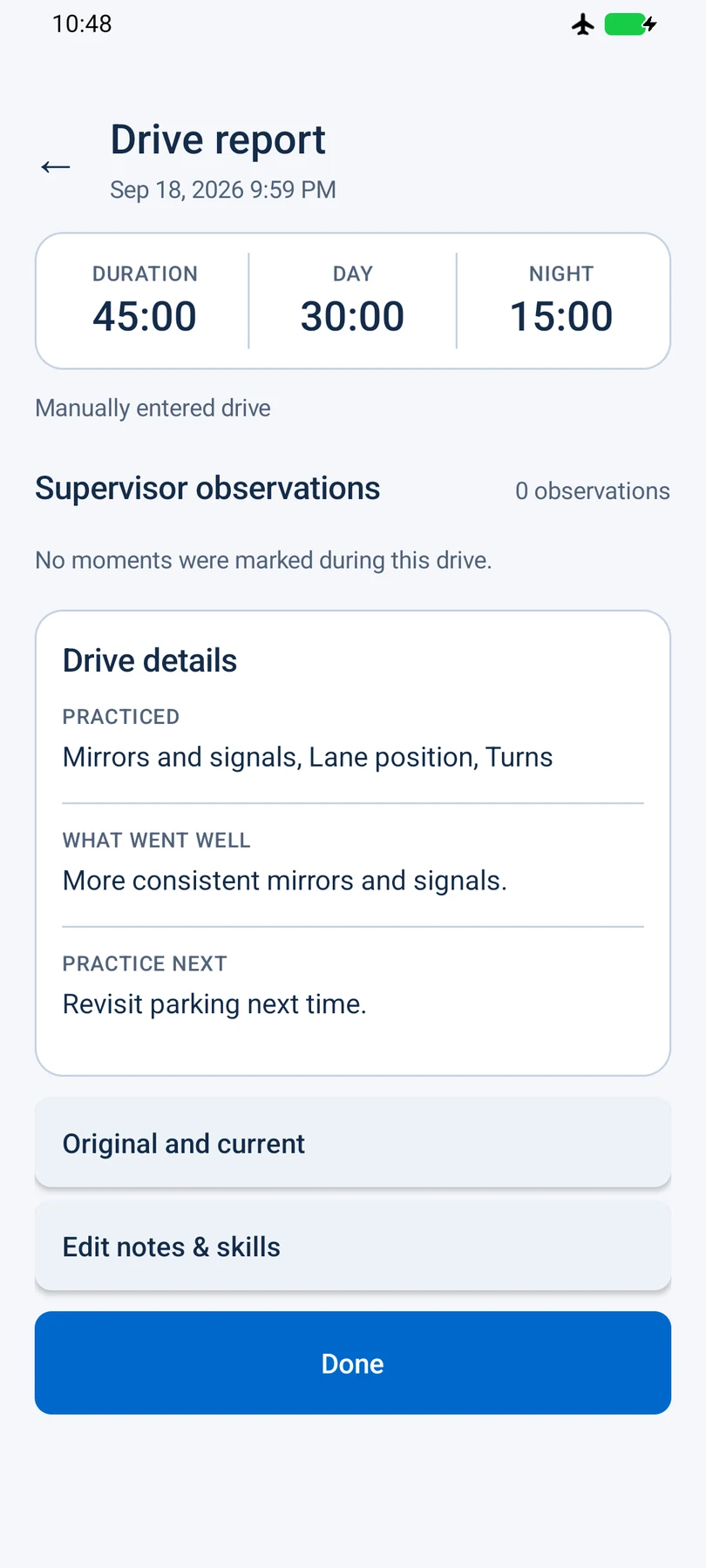
This sample manual entry keeps the duration, practiced skills, and two short reflections together. It has no GPS route and no supervisor observations.
The useful part is the context you chose to keep.